


The internet was already becoming soulless, but then AI came along and tore whatever was left of it out. That’s not to say the internet is dead - that probably won’t ever happen. It’s more “busy” than it’s ever been. But…it’s less alive in the human sense, as “souls” depart and it becomes more “artificial.”
This is not going to be a post about how much a Luddite I have become (although I must say, my desire for the simple life grows daily). Technology has and will always be with us. How we use it (or how it uses us), is the pertinent question.
This post is about opportunity - and a special kind of opportunity that is less about just “making money” and more about the more human act of “building value.”
In my last essay, I said that value itself always migrates to “zones of scarcity.” Here I’m going to expand on that and remind you that true opportunity is found in a particular zone of scarcity: the place where few people are looking.
AI - Where Everyone is Looking
I don’t know about you, but I’m all AI’d out.
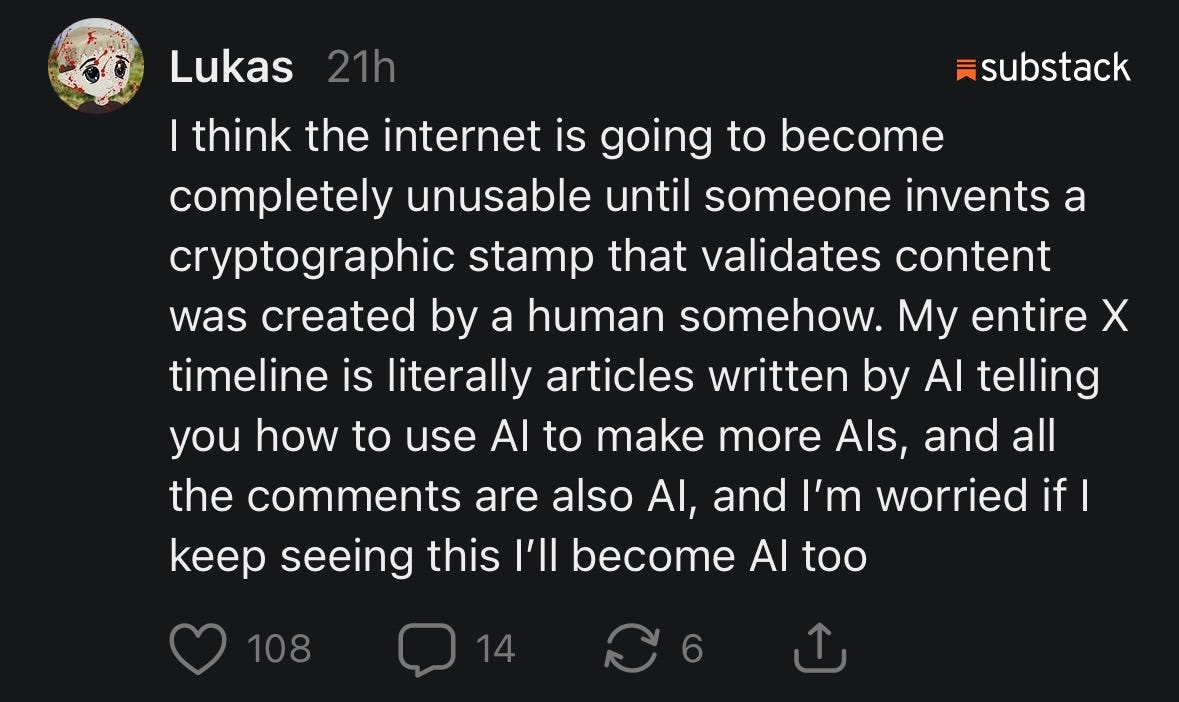
The AI space is over-crowded. I get emails every day from the VC-sphere about how many new startups are AI-startups, or AI-first, and how much money they all raised, and how 73% of YC’s latest cohort are all about AI, etc, etc, etc.
I don’t know about you, but that’s usually a red flag.
That’s not to say that AI is fake or that it’s going to fail. Absolutely not. But I’m less and less of the opinion that AI space is really about startups. The Google’s of this generation were already built. If you’re not OpenAI, Anthropic or a handful of others, I don’t see how you’re going to compete.
The only real players (and ultimately, beneficiaries) are Microsoft, Amazon, Google, Nvidia, etc.
I’m sure there are still opportunities in that space, but it’s like finding a needle in a haystack. Good luck with (a) separating the wheat from the chaff, and (b) building an actual moat against OpenAI, Anthropic, et al.
Very unlikely IMO.
From where I sit, the next region or sphere of opportunity lives at the periphery of the AI boom and all of the industries it is going to indirectly drive value towards.
On the periphery, energy is an obvious one. I would much prefer to invest in the picks and shovels that make AI possible. Whether that’s the data centres, or the energy generation plants / units that will be necessary for the technology to keep growing.
But this essay is not about Energy. It’s about the stuff that is going to boom because AI cannot copy or recreate it. It’s about the stuff that is an indirect beneficiary of AI’s relentless march forward.
It’s about what I’m calling “The Experience Economy” (for lack of a better term).
The Rise of The Experience Economy
As the name suggests, this economy is about the real, experiential world. Under this banner you could put anything from Travel ($12T), Events ($1.4T), Hospitality (hard to quantify), Wellness, Social Clubs, Offline Communities, Sports and any other kind of activity or experience that constitutes human beings doing things in the real world.
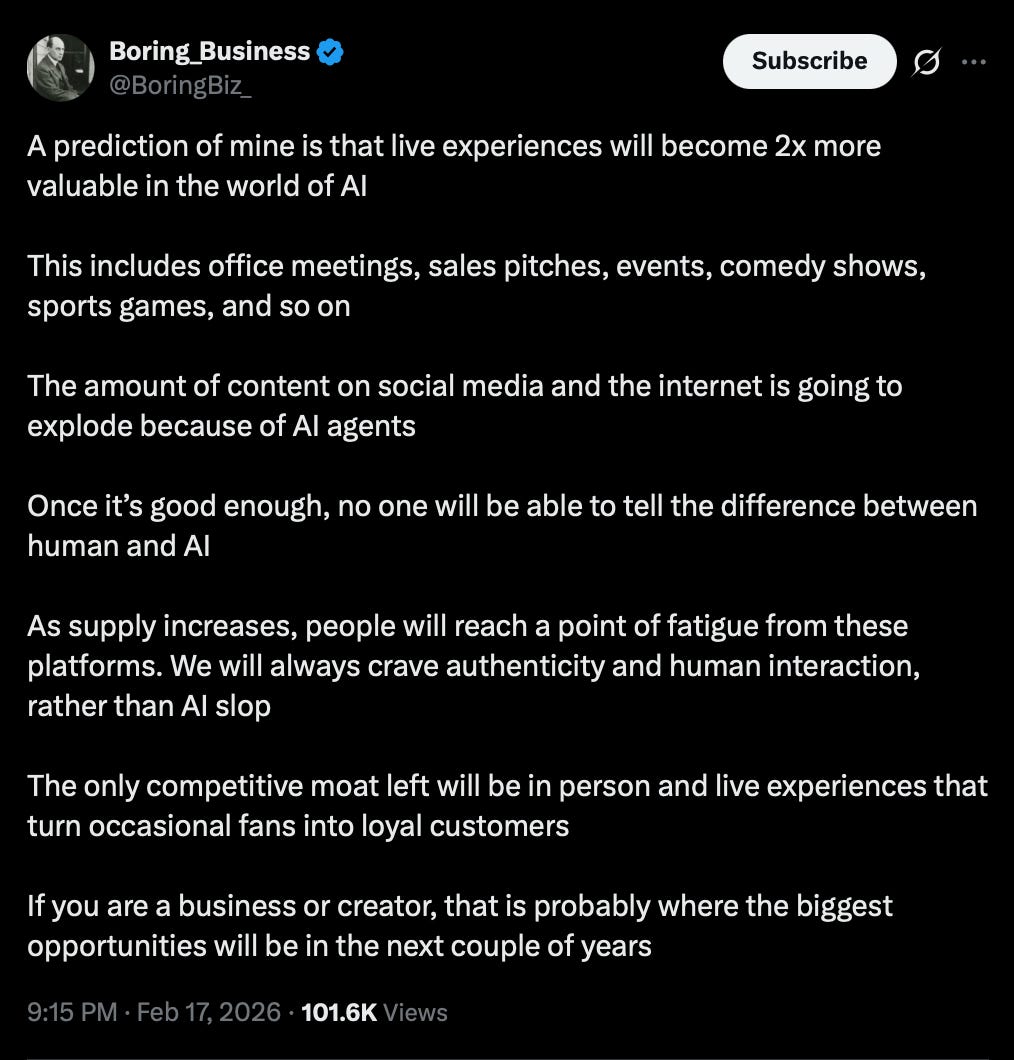
This space - the space of atoms - as Peter Thiel so aptly put it years ago, was ignored for a long time. But in recent years (post covid) we’ve seen a major boom in segments of it, like defence and space. This is probably because these benefit greatly from innovations in AI and “bits” - but also because they sound super cool (thank you Elon).
But more quietly, there’s also been a major boom in “atom” industries that were somewhat forgotten or thought too boring. Everything from super high quality hospitality establishments in key cities all around the world (I was just in Bali and Dubai and new venues are incredible), to stunning wellness spaces like Othership & Bathhouse that are enabling offline connection, to Equinox expanding into luxury hotels, and even Soho House moving into recovery and wellness. That’s to say nothing of travel, which has experienced a renaissance as people whiplashed the other way after being locked down for a couple years.
And then of course you have the rise of events, social clubs and offline communities - which is what I am interested in and I’ll elaborate on more below.
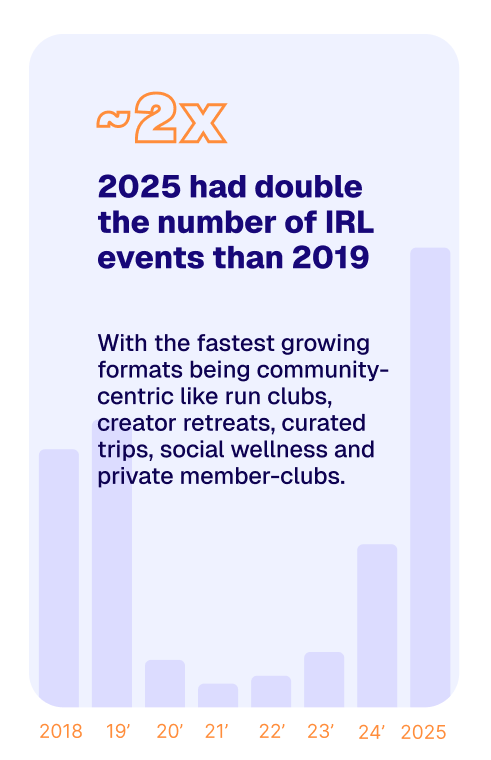
The question is, is this a short term “trend” or is this something more lasting?
I believe it’s the latter, with the lockdowns acting merely as a catalyst. What’s making this a long term societal shift is the simultaneous:
Rise of AI, agents, infinity-fication of the internet
The transformation of online social networks into social media
Together, these are turning the web into a place for bots, that’s too fast for humans, that’s becoming increasingly fake (you can’t believe your eyes or ears anymore), feels like a strip mall (everyone’s trying to sell you something), and rage inducing (it’s an always-on news channel that feeds on your attention).
As a result, instead of connecting us, it’s disconnecting the hell out of us - which is hardly a novel insight. But…something has changed recently (and I truly believe AI had something indirect to do with it).
Offline Social Networking
For a while now, people have been talking about going more local, building a local community, switching off the news, etc.
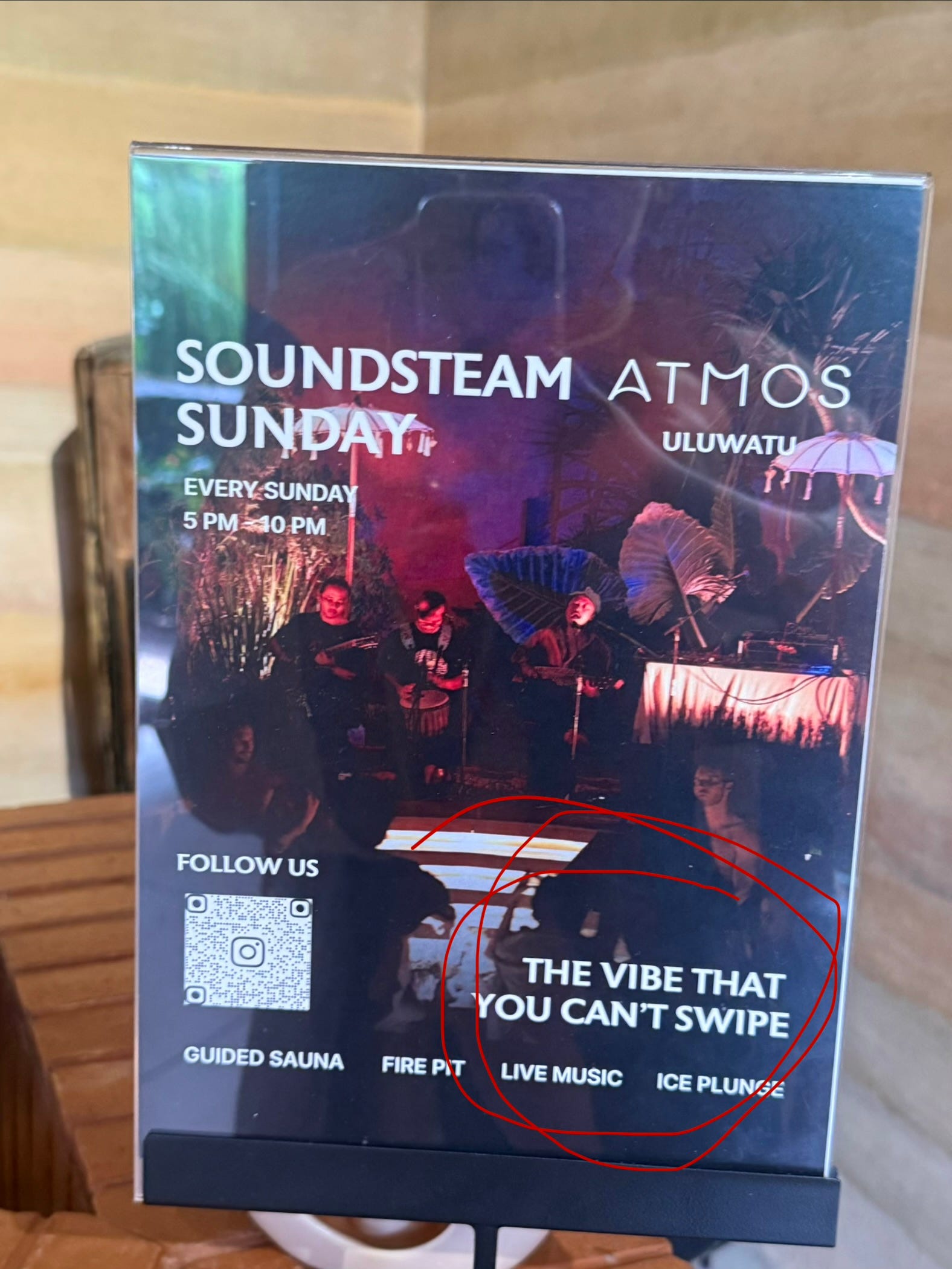
I feel like we hit a tipping point last year - a bit like the tipping we hit with the food pyramid. The move offline has actually become cool. The internet and social media is increasingly uncouth. Staring at a screen all day signals loserdom. Getting on a dating app is seen as desperate. All of the ‘cool’ places like Dubai, Bali, Medellin, Miami are advertising things like this:
Algorithms crippled online social networks (by turning them into social media).
AI (LLMs and agents) was the killshot.
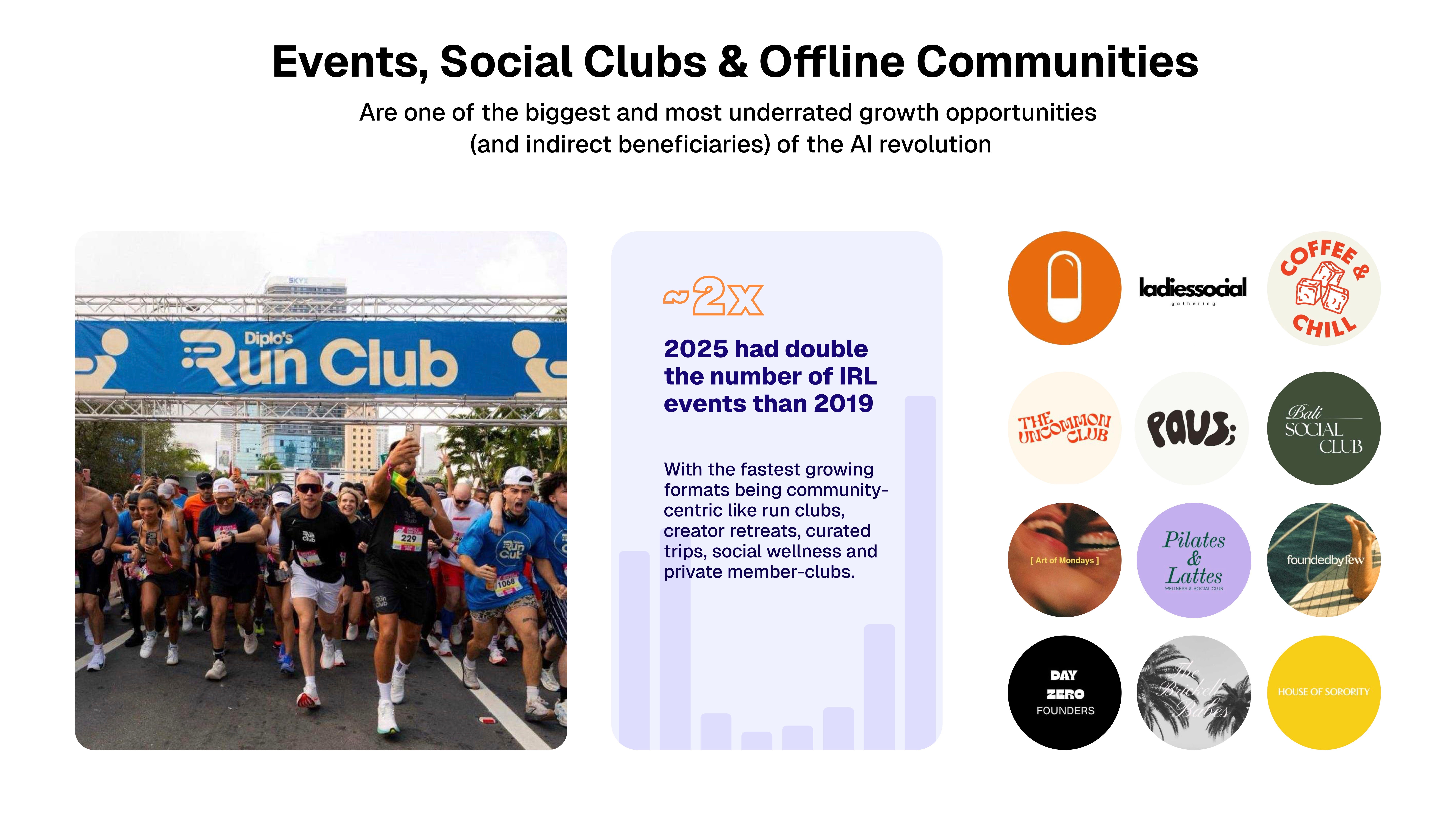
As a result, what I’ve been saying for over a while now, which I’m reiterating here is that over the next 5 years, social networking is going to increasingly move offline. And it’s all going to happen through events, experiences, social clubs and offline/hybrid communities.
This means anything from a dinner through to a retreat and up to a conference. Or a run club, a women’s social club, a private men’s club, or the hundreds of creator, entrepreneur and lifestyle clubs and communities popping up all over the world.
I don’t care if it’s existing event organisers, or creators or brands - they are all going to become increasingly “community” oriented, and look to build deeper relationships with and turn their audiences & their customers into real, IRL communities.
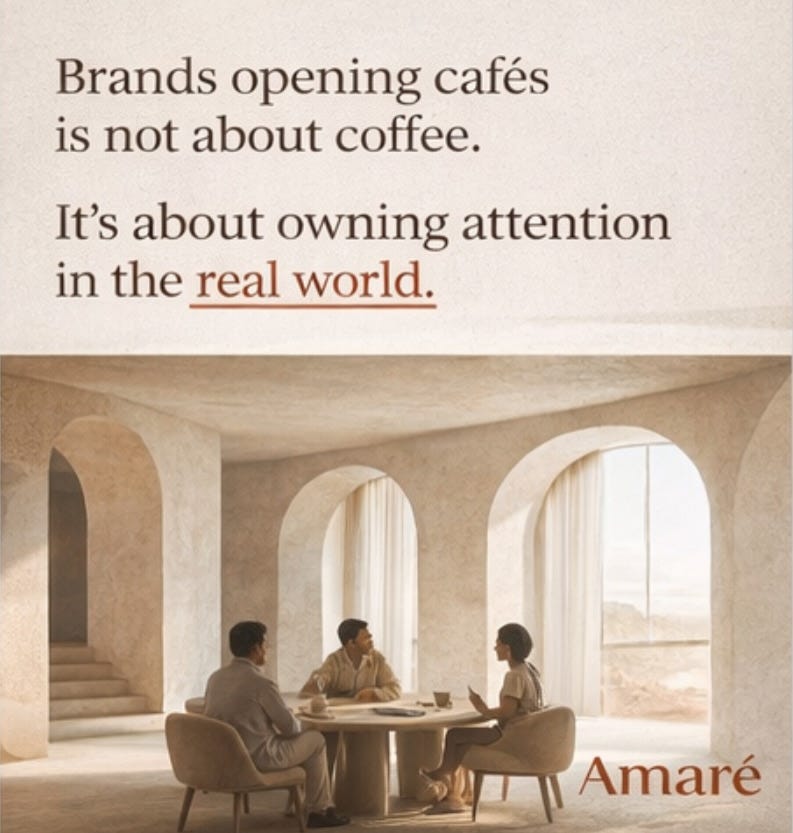
Even physical venues like retail shops & cafes will undergo a massive transformation (they already are) into spaces that people want to come to and hang out in. I saw this a couple months back, and it reflects what I saw in real life while I was traveling, and what I mentioned above about brands like Othership, Soho House and Equinox (not to mention the tens of thousands of others around the world).
Ok Svetski - but what about the robots?
What happens when AI comes to the real world?
What then?
I’m glad you asked.
Quantity > Quantity. Human > Artificial
I’m sure we’ll get to the point where robots are infused with some sort of AI powers and will become useful enough to function as cheap slave labour.
But even so, it won’t devalue “organic connection”.
If anything, it will create more of a premium for experiences which are organic, natural, more wholesome and more human.
The experiences which are cookie-cutter, copy/paste (like the online tasks that were too, eg: journalism), will be commoditised and probably handled by robots and AI. And that’s perfectly fine.
Value ALWAYS migrates to the zone of greatest scarcity. So as AI eats the internet by making what it’s composed of infinite, and as it spreads into the physical, experiential world through tendrils made of robotic machinery - it will do the same thing: devalue and commoditise all that is of low to medium value experiences.
The result is a mixture of value creation and value destruction.
Destruction for anyone that’s providing anything of low or mediocre value. The less organic and human, the more likely it is to be replaced by a machine.
Value creation for two other kinds of player:
The giant monopolies who own the AI and robots.
The operations which are maximally human and organic, whose very selling point is “not-AI/machine” and “natural”
The second player will not necessarily be anti-technology (although some may be). But they will use technology, AI and robotics behind the scenes in order to deliver an experience or service that is of super high quality, ultra-personalised and extremely human.
It’s Wholefoods 2.0, but applied to everything else in the real world.
One very simple example is a massage.
I’m sure we’ll get AI-powered massage robots who can give a better massage than your run of the mill masseuse at your local massage-franchise, for a cheaper price. This is perfect for the “masses” who cannot otherwise afford a weekly massage, and quite frankly don’t have the necessary physiological refinement to know the difference between a masseuse and body worker (not unlike wasting Foie Gras on someone who lives on McDonalds).
Myself, and many others like me, will go to the body-worker who is a master of their craft, who appreciates touch as sacred, who does it for the love of what they do, and because it’s a service or experience given by the few, for the few.
We will pay extra because it’s human, and it’s rare.
That’s how status and luxury work now, how they worked before and how they will forever work. Hermes, Hublot and Ferrari are valuable because they’re rare, scarce and unavailable to the masses. You pay extra for something that’s handcrafted because it CANNOT be mass-produced. You pay 10x what you would at McDonalds (for less calories) at a Michelin Star restaurant.
I literally just had a friend send me an IG reel of physiotherapy and Thai massage specialist, with 906k followers. This is exactly what I’m talking about, and it’s happening now. AI will only magnify it. The ones in trouble are middle of the bell curve, whether that comes to knowledge/online work, or experiential/offline work.
Summary
In a world where technology is only going to move faster and the internet is going to get more crazy, more polarised & more tribal - the only real bet I‘m willing to make is that humans will remain physical beings and that human nature will remain social.
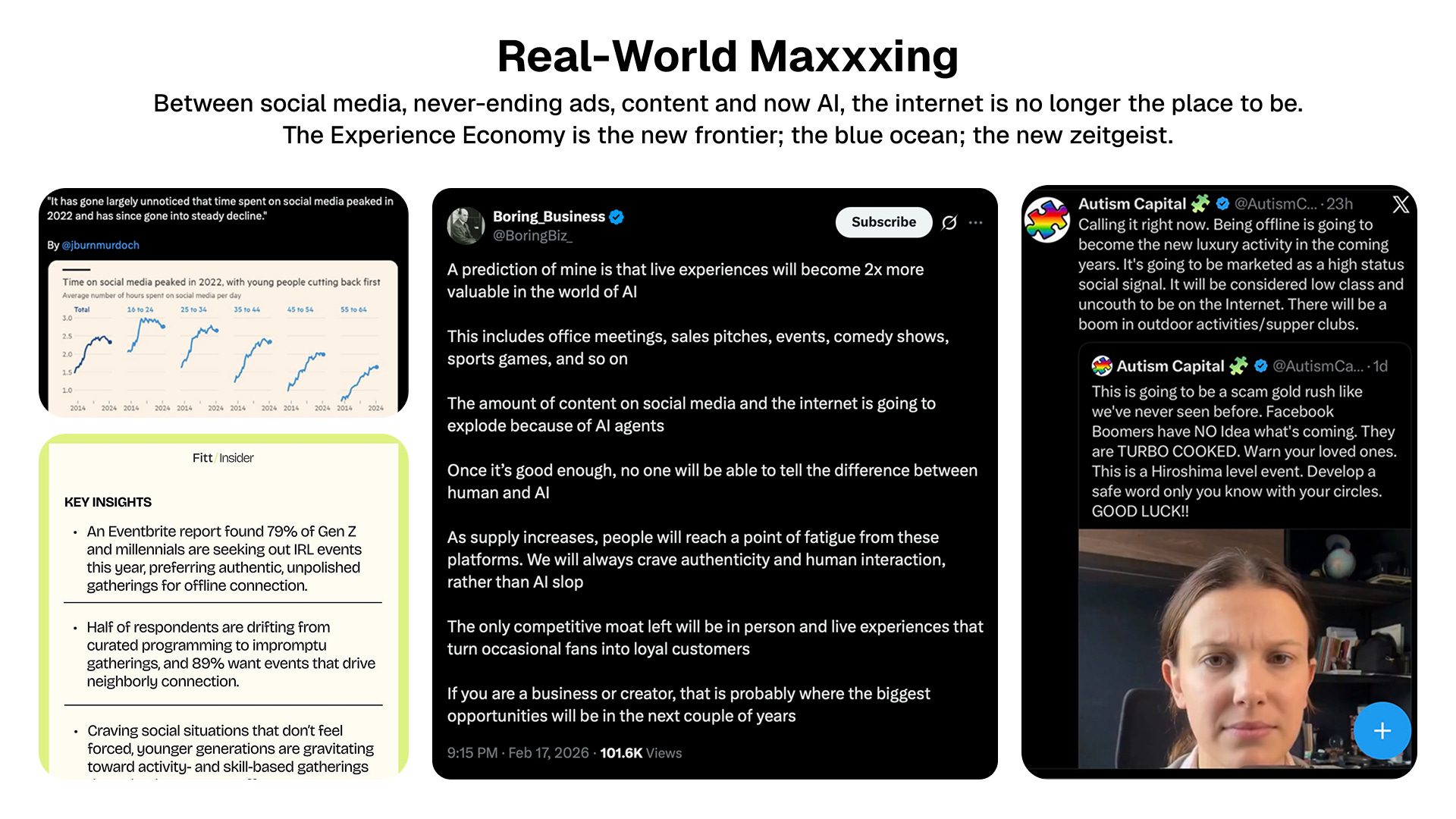
And clearly, I’m not the only one:

Five different people who know what we’re working on at Satlantis sent me this tweet (My social media digest comes via screenshots and links on WhatsApp or Signal…lol).
This is the new Zeitgeist. Mark my words.
There was Bitcoin, there was Sun, Steel and Steak, now there’s Peptides and the Experience Economy. These are unique contrarian bets not just because people didn't see them coming, but because they are “reactions” to larger, overarching trends. Bitcoin was a reaction to monetary debasement, Steak was a reaction to Beyond Meat, Peptides were a reaction to body positivity & transgenderism and Experiences are a reaction to the never-ending dopamine dispenser we call Social Media
So…
As AI continues to eat the internet, more value, more people and more social activity will migrate offline. Events, experiences, social clubs, IRL Communities, curated trips, date nights, you name it. This is where the opportunity is. This is where the puck is going. This is where I am playing. This where you should go.
If you read my last post, you know what I’m doing. I’m trying to live this life, and to position myself in a way that will benefit from this societal shift.
I firmly believe that someone is going to build the platform & marketplace for experiences and IRL communities, and they’re going to be one of the next big global consumer applications.
My team and I plan to be in the running for this prize, with what we’re building at Satlantis.
If you’re interested to learn more, you can reach out to me here on Substack, or via email: as@satlantis.io
Thankyou for your attention. Forgive the shill at the end. I genuinely hope you found this valuable.
Aleksandar Svetski
P.S. - If you’re interested in learning how to build one of these communities or how to use this tool, the Jordi is hosting a webinar this coming week which you can subscribe to here: https://www.satlantis.io/events/1837
P.S.S. - If you don’t have time for that, but want to learn more about the platform, Steve McGarry did a really good video the other day covering it on YT:
I agree with you. I suspect that people are going to switch to AI-agents to interact with most of the internet. It simply isn't worth your time to dig through bot-posts to figure out what's real and what isn't. Our distance horizons will shrink to more local communities with not-AI being a feature. The opposite of enshitification maybe. We're still going to have to square the circle on tech-giants owning half the capital, but I think that's doable under sufficient cultural pressure.
I've been considering my own article on the topic. In the mean time, I think that as we migrate away from a performative digital culture we're going to see a push towards properly throwback traditionalism. Partially led by the New Right and partially as the mere product of larger trends. See my article on the subject of shifting fashion trends: https://alwaysthehorizon.substack.com/p/the-return-of-formality-bringing?r=43z8s4
god i hope